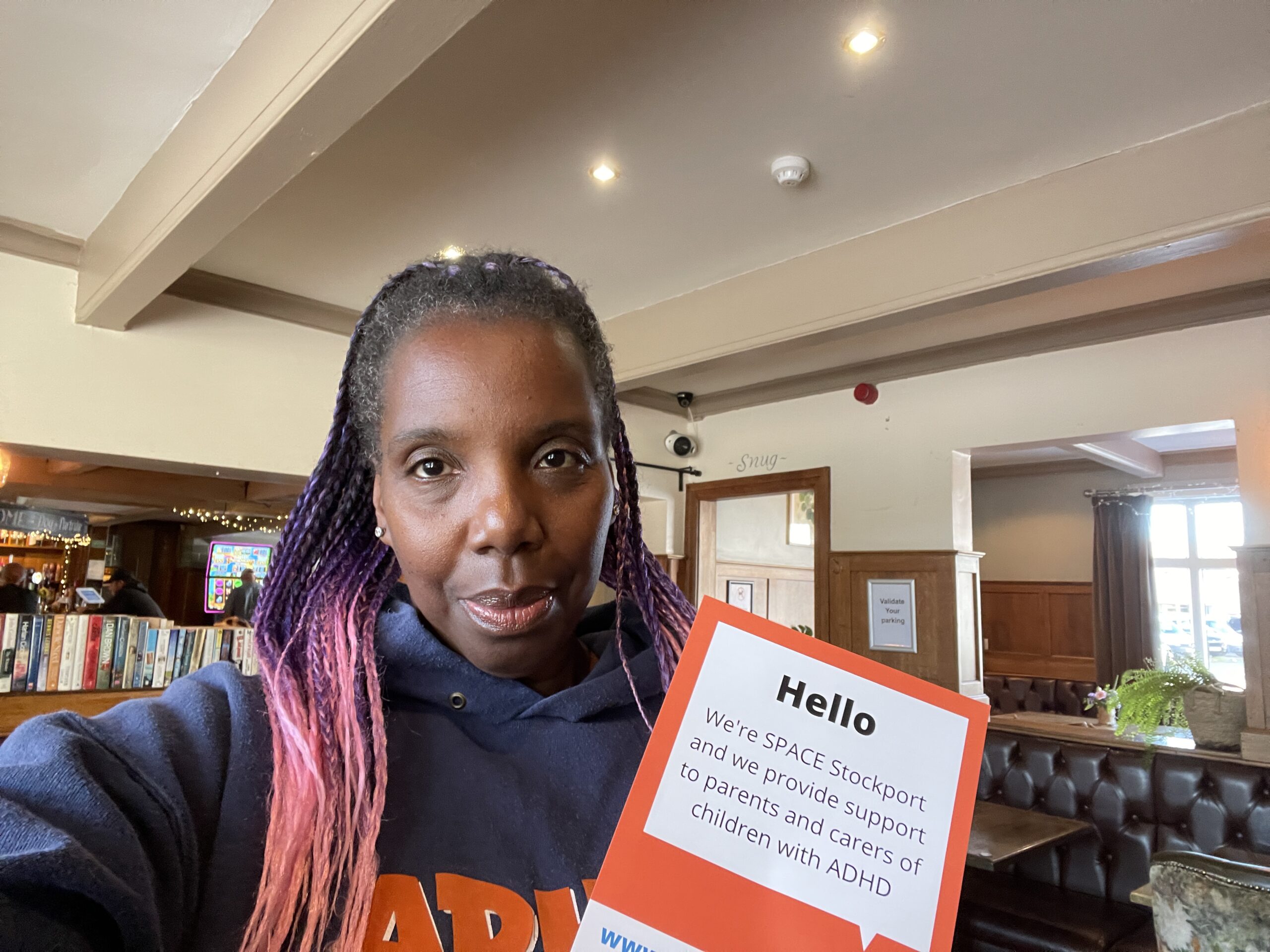
October is ADHD Awareness Month and when I’m not building websites or teaching people how to do things online, I’m the Chair of a small charity that supports families who have children with ADHD. This month our charity S.P.A.C.E. has posted on our socials more than usual and are also sharing some new guest blog posts. I made a conscious decision a while ago to talk less about how ADHD affects me, but as it’s ADHD Awareness Month I thought I’d let this blog post out of my notebook and actually publish it. My post The Cap, The Gown and The Niggle. Graduation 2018 was probably the last time I mentioned it on here so an ADHD post was probably overdue.
I was at an event a few years ago where somebody told an anecdote about me that was absolutely untrue. I was mildly annoyed, but not angry. The reason I wasn’t angry is because whilst the conversation they relayed definitely never happened, the person in question probably thinks that it did. They know that I have ADHD and they also know that lots of people with ADHD need lots of physical movement. Their recollection was that I said that “I can’t sit still” At this point you may be questioning how I’m so sure that this conversation never took place. Well firstly because I know it didn’t and secondly because I can sit still and frequently do so. Sitting still isn’t something that I struggle with. I can sit still for hours. As a teenager I sat on a stool for 18 hours to get my hair braided and whilst I’m not bothered enough about my hair to do that again, I still regularly spend 3 – 4 hours braiding my hair and many more sat on my arse watching TV or playing on my iPad. I love sitting in one place. I’d rather not do it in silence, but I can absolutely sit still.
I don’t like to be misunderstood, so my tolerance for being misquoted is reducing, but as I like and respect the person concerned and know that there was no malice in it, I let it go. It was a few years ago and I’m not planning to ever bring it up, but it has been sort of noted.
A while ago a friend innocently said that they “know I lose focus”. They don’t know that. They know that I have a diagnosis of ADHD and apply their understanding of that condition to me from time to time. I did gently correct them with a “not really.” It isn’t a huge problem, but I’m becoming increasingly irritated with these misunderstandings.
ADHD has a huge P.R. problem. The stereotype has changed slightly over time (but not much) and having ADHD is definitely less of a dirty little secret than it used to be, but those with the condition are still generally being scrutinised by others. Those with ADHD have their actions ran through an external, under-informed ADHD filter to apply understanding and meaning.
Dr Tony Lloyd, formerly of the ADHD Foundation once said “Once you’ve told someone you’ve got ADHD, you can’t un-tell them” and he’s absolutely right. Once a diagnosis has been shared with somebody you have no control over how that information is used, shared or how their version of the ADHD filter will be applied to your actions.
This is one of the reasons why I hate it when other people announce somebody’s ADHD. It’s not a secret, but it should be my decision whether a person I’ve just met is told about my diagnosis, particularly when it is rarely relevant and I have no way of knowing how that announcement will be interpreted. The other person may not know much about ADHD and to them the words “This is Claire and she has ADHD” could be saying
- This is Claire, she’s unreliable
- This is Claire, she can’t sit still
- This is Claire, she’s always forgetting things
- This is Claire, she’ll be late all the time
- This is Claire, if she sees a squirrel she’ll lose her mind
None of that would be true, but it’s too late now, you’ve told them that I have ADHD and now I’m subject to whatever stigma, misinformation and stereotypes they feel like applying to me.
The poster child for ADHD is still a noisy, fidgety, white, annoying, male, between the ages of 7 and 16. The memo that ADHD also affects girls and adults has been circulated and skim read by much of the population, but when encountering ADHDers in the wild, people are still looking for fidgeting, forgetting things, noisy outbursts and “look squirrel!” Once we can get the general public to look past the “Bart Simpson” default behaviours, we’ll be in with a chance of genuinely supporting those with ADHD, rather than making people with ADHD stop annoying us.
ADHD is complicated and can be hard to identify. There isn’t a blood test for it and our behaviours are technically the same as everybody else’s – we just tend to supersize some of them. Everybody does the same things as people with ADHD, they’re just not ruining their lives with the frequency, intensity and unpredictability of those things. Nobody’s executive function runs at 100% 24 hours a day, 7 days a week, but most people’s aren’t MIA on a regular basis. Everybody gets distracted, forgets things and behaves impulsively at times, it’s usually the scale that’s the problem.
ADHD isn’t necessarily a bad thing. It also isn’t necessarily a good thing. The ADHD Superpower narrative works well for many, but it has a few flaws. Superman appreciated his powers because he was able to use them when he wanted. Falling helicopter – use your super-strength to catch it and make sure it doesn’t crash into innocent bystanders. Damsel in distress – fly to her rescue and deposit her gently on the ground. I doubt if Superman’s powers would have been quite so cool if he unexpectedly started flying whilst he was grocery shopping or his super speed kicked in when he was on a slow romantic stroll with Lois. Power without control is chaos and often the dangerous kind.
There are lots of ADHD traits and behaviours and whilst there are certain ones that people recognise, usually the visible, audible ones associated with naughty boys, once we zoom out and consider how ADHD looks for 14 year old girls, 30 year old men, 50 year old women etc. we see that it doesn’t look the same for everybody and that how it looks can change over time. One of the many downsides to ADHD only being viewed through the lens of 10 year old boys is that people have only recently started looking at how it is affecting everybody else. There are lots of common ADHD traits and most people with ADHD will regularly display some of them. ADHD is commonly characterised by inattention, hyperactivity and impulsivity, but how that looks out in the wild varies a lot. I know people with ADHD who fidget constantly. I know people whose legs physically bounce, because that is how their ADHD manifests. I can keep my body still, but I can’t always say the same for my mind. I talk a lot, but I can be quiet. Not everybody can. I had to learn how to be quiet. I had to practice letting others have their say. As a youngster everyone was entitled to my opinion.
Celebrities sharing about their ADHD has done a lot to raise awareness, but unfortunately many of them feel that their lived experience is the “correct” version of ADHD and most of them don’t have the knowledge and / or self awareness to recognise that they don’t know as much as they think they do. As a result we hear soundbites from their interviews and hear their personal views touted as gospel, which is very frustrating. When somebody with 4.7 million Instagram followers announces that ADHD is caused by ultra-processed foods and a lack of exercise, unfortunately people think they’re right. They’re not.
Is exercise and healthy nutrition a good way to help manage your ADHD? Yes. Absolutely.
Did eating pot noodles and dodging the gym ever cause anybody to have a neuro-developmental condition? No. Absolutely not.
Getting the right information matters and as much as I love the internet, influencers have got a lot to answer for.
Happy ADHD Awareness Month!
This is Claire, she’s amazing….
Thats what they should say.
You gave me hope and friendship when my son received his very ADHD diagnosis at 15 and helped us navigate support when the world seemed a harsh place.
Eleven years on he’s engaged, hard working and the most genuine and sensitive soul.
Every person deserves to have a happy ending with the right understanding and support – keep doing what you’re doing Claire ☺
Thank you so much. We’ll be here for as long as people need us. I originally came along to S.P.A.C.E. as a parent, so I know how it feels.
Thank you so much for commenting. It’s always nice to hear from parents who are on the other side of the teenage years.